.png)


What Fibroblast Treatment Refers To in Practice
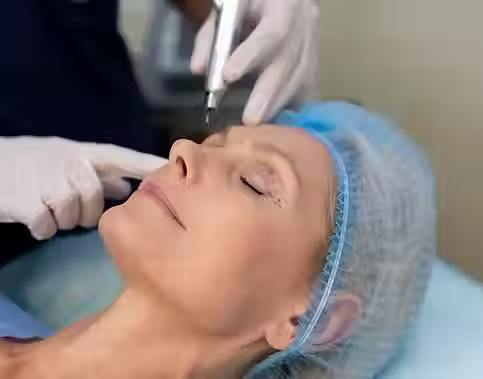
The term fibroblast treatment is commonly used to describe plasma pen or fibroblast plasma treatments: a handheld device that strikes the skin with a small electrical arc, creating a controlled thermal injury and visible carbonized dots on contact. Each contact point darkens into a tiny dot, and as those dots heal over the following week, the surrounding skin contracts and tightens, most often around the eyelids, jawline, and neck.
Plasma pen technology uses a direct electrical arc to create that controlled thermal injury, which initiates a wound-healing response, and that response contributes to the skin tightening patients see as it heals. Fusion Plasma CAP works through a separate mechanism, supporting the skin's own regenerative processes through non-thermal energy.
Fusion Plasma CAP's Foundation in Regenerative Science
At PlasmaLift Skin Clinic, our main service is Fusion Plasma CAP, developed as its own standalone category of skin technology. Healthy skin is built, not manufactured, and that governs the engineering itself: the device is designed to support healthier skin by supporting collagen, elastin, and the skin's own regenerative processes, rather than damaging the surface first. Fusion Plasma CAP supports collagen and elastin production along with healthy cellular renewal over the course of treatment.
See how this technology extends across the broader area of Fusion Plasma CAP in Quad Cities, and read Why Fusion Plasma CAP Is Different for a full breakdown of the non-thermal design.

How Fusion Plasma CAP Compares to Plasma Pen Treatment
Fusion Plasma CAP vs Plasma Pen comes down to one core distinction in mechanism. Plasma pen technology relies on controlled thermal injury and the wound-healing response that follows to achieve skin tightening, which is why patients see visible carbonized dots and scabbing at each contact point during the healing week. Fusion Plasma CAP uses a non-thermal approach that does not rely on creating carbonized dots or controlled thermal injury, instead supporting the skin's own regenerative biology.
The practical differences follow from that one distinction: how the skin looks immediately after treatment, how long visible recovery takes, and whether results depend on a wound closing or on the body's own regenerative timeline.
Why Temperature Separates These Two Plasma Technologies
Cold Atmospheric Plasma vs Plasma Pen is fundamentally a question of heat. A plasma pen's arc reaches temperatures hot enough to burn tissue on contact, by design. Fusion Plasma CAP delivers non-thermal Cold Atmospheric Plasma technology, designed without relying on controlled thermal injury to achieve its effect.
Fusion Plasma CAP uses non-thermal plasma energy to support the skin's natural regenerative processes without relying on controlled thermal injury. CAP Therapy refers to this non-thermal category of treatment, distinct from the carbonized dots and wound-healing response that a plasma pen depends on to create tightening.

Skin Concerns Fusion Plasma CAP Is Commonly Used For
Moline residents researching plasma skin tightening in Moline, Illinois, usually notice specific, identifiable changes: the jawline losing its sharp edge, skin along the neck starting to lose tension, or early creases forming around the mouth and forehead. Fusion Plasma CAP is commonly used to support these concerns, including crepey skin, loose skin, fine lines, wrinkles, uneven texture, and enlarged pores, working with the body's own regenerative processes in each treatment area. This falls under the category of regenerative skin therapy and broader plasma skin tightening, delivered as a professional in-office treatment, and sits within Non-Surgical Skin Tightening more generally.
Patients dealing with more than one of these changes at once frequently pursue regenerative facial rejuvenation in Moline, Illinois, a plan covering multiple zones in a single course of care, sometimes called simply regenerative facial rejuvenation, part of the broader field of regenerative aesthetics centered on supporting skin health directly.
Inside a Fusion Plasma CAP Treatment Visit
Your appointment starts with your practitioner mapping which areas show the most change. The treatment approach is adapted to the characteristics and needs of each treatment area, with the Cold Plasma Treatment itself moving through a controlled, methodical pass.
Because nothing gets carbonized, there's no scab-and-heal cycle to track. Because Fusion Plasma CAP is non-thermal, it does not create the carbonized dots that are characteristic of plasma pen treatments, and recovery timelines vary by patient depending on the treated area and individual skin response. As a category of plasma skin rejuvenation, visible improvement develops gradually as collagen remodeling and cellular regeneration continue over the weeks following treatment.

How PlasmaLift Skin Clinic Serves Moline Patients
PlasmaLift Skin Clinic is located in Bettendorf, Iowa, conveniently serving patients throughout the Quad Cities, including Moline, with a core technology: Fusion Plasma CAP. Your consultation opens by identifying exactly what you searched for and what the treatment delivers, since patients frequently arrive expecting plasma pen mechanics and leave understanding a completely different technology.
With the same practitioner handling your case from that first conversation through your final session, at PlasmaLift Skin Clinic, our goal is simple: healthier skin that still looks like you. We believe healthy skin is built, not manufactured, and every treatment plan reflects that philosophy.
Frequently Asked Questions
Why does a device unrelated to fibroblasts get called fibroblast treatment?
Fibroblasts are cells in the dermis involved in producing components of the skin's extracellular matrix, including collagen and elastin, which is why the name became associated with skin-tightening treatments aimed at that goal. A plasma pen reaches that goal through a wound-healing response triggered by controlled thermal injury, while Fusion Plasma CAP takes a different, non-thermal approach to supporting the skin's regenerative processes.
Can patients with sensitive or acne-prone skin use Fusion Plasma CAP?
Candidacy is determined individually based on skin condition, treatment area, medical history, and the specific concern being treated. Your practitioner evaluates your skin during a consultation before recommending a plan.
Is fibroblast treatment the exact same procedure at every clinic?
Not always. "Fibroblast treatment" typically refers to plasma pen devices using a direct electrical arc, but the specific device, wattage, and technique can vary by practitioner. Fusion Plasma CAP is a distinct, non-thermal technology that some patients compare to fibroblast treatment while researching, even though the underlying mechanisms operate on entirely different principles.
Does Fusion Plasma CAP leave the same carbonized marks as a plasma pen?
No. Carbonized dots form when a device generates enough heat to char the skin's surface, which is exactly what a plasma pen is engineered to do. Fusion Plasma CAP uses non-thermal energy, so that a thermal signature never develops.
How many Fusion Plasma CAP sessions does skin tightening generally require?
It depends on your current skin condition, what you hope to achieve, and the specific areas you want to treat. Some patients see change after one session, while others benefit from a series of sessions spread out over time.
Does living in Moline mean I need to travel for treatment?
Yes, PlasmaLift Skin Clinic operates from a single Bettendorf location, a short drive from Moline, serving patients throughout the Quad Cities from that one clinic on Middle Road.
If you've been comparing fibroblast options near Moline, PlasmaLift Skin Clinic can walk you through where Fusion Plasma CAP fits during a consultation.